
STAT-X DEUTSCHLAND · COMPETENCE CENTRE
Your practical questions.
Our knowledge from experience.
Real customer questions, detailed explanations and experience from consultancy, training and measurement workshops.
What lies behind an unusual measurement? Why does a protective measure fail to work as expected in everyday use? We explain the connections and show practical approaches.

These questions arose in discussions with customers and participants in our events. The answers draw on technical knowledge, our own investigations and exchanges of experience with those responsible for ESD. Examples from earlier workshops are identified by their historical context.
There is no such thing as a stupid question. Open the question that matches your situation: you will find the background, a detailed explanation and practical guidance.
All 17 questions at a glance
Materials and workplace
- What ESD information must a product datasheet contain?
- Antistatic bags – why are pink bags not always sufficient?
- Why should I not ground my trolleys with a drag chain?
- A grounded metal shelf causes ESD failures – how is that possible?
- Why can I not simply ground an insulating surface with a cable?
- Is humidification a sensible ESD solution?
- How directly should soldering tips be grounded?
- Can disinfectants damage ESD bench mats?
- Why should insulators unrelated to the process be identified as soon as they enter the EPA?
Testing and measurement
- Is a 100 V test voltage a problem for pregnant employees or people with implants?
- Why does an employee fail the ESD test in the morning?
- What practical problems can I avoid in a walking test?
- Why did a consultant’s high-resistance measurements differ from mine?
Organisation and qualification
Materials and workplace
What ESD information must a product datasheet contain?
From our seminars: is it sufficient for a supplier to confirm in the datasheet that its product meets IEC 61340-5-1 requirements?
Our answer
This statement alone does not establish whether the product is suitable for your specific use. You need the property tested, the test method used, the measured values and the test conditions. Only then can you assess whether the evidence matches your application.
A typical example is a dissipative tray: initially intended to package components, it is later used as a workpiece carrier in a machine. Suitability as packaging does not automatically demonstrate that the requirements for the work surface and dissipation path are met once installed.
Resistance values are not interchangeable either. Point-to-point resistance describes a different setup from resistance to ground. A material value alone also does not account for contact points or how the tray is integrated into the machine.
For your practice
Ask the supplier specifically: which property was measured, using which method and under what conditions? Compare this information with the actual use. Then document the application for which the product is approved.
Antistatic bags – why are pink bags not always sufficient?
Question from the 2017 logistics workshop: why are simple pink bags insufficient for transporting electronic components?
Our answer
“Antistatic” and “ESD protective packaging” do not automatically mean the same thing. Low charging, dissipative properties and discharge shielding are different characteristics. Pink colouring does not reliably prove any of them.
A simple plastic bag with an antistatic additive may reduce charging but does not automatically provide effective discharge shielding. For ESD-sensitive components outside a protected environment, packaging must provide the required protective functions. Documented properties and the intended transport route are decisive.
What we observed in the workshop: In that comparison, residual charge was still detectable on one bag sample after 17 seconds; the other sample dissipated the applied charge in less than two seconds. The original report stated point-to-point resistances of 150 GΩ and 200 MΩ respectively at approximately 53% relative humidity. These are results for the tested samples, not universal values for all pink or dissipative bags.

For your practice
Choose packaging by its demonstrated protective function, not by colour or marketing label. Also check suitability under expected climatic conditions. Manufacturer information, clear product identification and batch traceability make approval and subsequent investigation of deviations easier.
Why should I not ground my trolleys with a drag chain?
From practice: the trolley has a grounding chain. Why is the dissipation path still unreliable?
Our answer
The chain works only while it maintains sufficiently conductive contact with the floor. While moving, it may bounce or touch the floor with only a few links. Unevenness, speed and chain weight affect this contact.
A heavy chain is more likely to stay on the floor but also picks up dirt. A light chain may lift off more easily. The previous Stat-X practical account reports that effectiveness can deteriorate significantly after only a short period of use. This explains why an unremarkable measurement on a stationary trolley does not represent every transport situation.
Suitable conductive or dissipative castors can provide more consistent contact. The castors must be electrically connected to the trolley and run on a suitable floor. Dirty treads or insulating connecting parts can also impair this solution.
For your practice
Check the complete dissipation path on the trolley and consider actual movement and floor condition. Choose castors and maintenance to suit the overall system. A particular number of “ESD castors” alone does not demonstrate functionality.
A grounded metal shelf causes ESD failures – how is that possible?
A galvanised metal shelf is connected through a grounding cable with a 1 MΩ safety resistor. Why do ESD failures still occur?
Our answer
The resistor in the grounding cable does not automatically limit the initial charge equalisation between a charged assembly and the shelf. On direct contact, the assembly meets a highly conductive surface. Charge can spread across the metal very quickly – before dissipation to earth becomes the decisive factor.
The original practical case particularly considered the shelf’s electrical capacitance. A large metal body can form a substantial charge reservoir relative to the small assembly. A resistor further along the grounding path does not eliminate this immediate contact.
A suitable dissipative support surface can influence charge equalisation at the contact point. Its effectiveness depends on the material, contacts and integration into the shelf. Charging of the assembly before it is placed down must also be considered.
For your practice
Assess the surface on which the assembly actually rests. If an additional support surface is used, check the dissipation path through the entire arrangement. Whether a separate grounding connection is needed depends on this setup and the manufacturer’s instructions – not merely on the fact that the metal shelf is already grounded.
Why can I not simply ground an insulating surface with a cable?
From consultancy: a grounding cable is attached to a plastic surface. Why does the surface remain charged?
Our answer
A grounding cable helps only where charges can actually reach the connection. Charges can move comparatively easily in a conductor. In an insulator, they remain largely bound to where they originated. A cable at one corner therefore does not reliably remove charge from the rest of the surface.
There is also a terminology pitfall: “insulating” is used differently depending on the technical field and test task. The specifically measured property and the method used are therefore decisive.
How quickly charge dissipates depends not only on resistance but also on capacitance, geometry, contacts and surroundings. The label “conductive” or “dissipative” therefore does not imply a fixed discharge time for every component or surface.
For your practice
Remove or replace unnecessary insulators. For materials required by the process, assess suitable distances, process arrangements and, where appropriate, ionisation. An additional cable alone is not a reliable solution for an insulating surface.
Is humidification a sensible ESD solution?
From practice: more charging occurs in winter. Can we solve the problem by increasing humidity?
Our answer
Humidity can change the electrical properties of certain materials. For some surfaces and hygroscopic additives, moisture improves charge dissipation. Products may therefore perform without issue in more humid conditions but cause problems during dry winter periods.
However, this effect depends on the material. Higher room humidity does not mean that every plastic becomes sufficiently dissipative. A protection concept that works only in favourable weather remains vulnerable to seasonal fluctuations.
The original article also discussed the costs of installing, operating and maintaining a humidification system. These remain relevant to the decision. Humidification should be justified by the needs of the entire operation; as the sole ESD measure, it is not a reliable substitute for suitable materials, grounding and process design.
For your practice
Qualify protective measures for the expected operating conditions and the prescribed test conditions. If a necessary insulator develops problematic charge, specifically assess ionisation and process design. Record temperature and relative humidity during measurements so that seasonal differences remain traceable.
How directly should soldering tips be grounded?
A customer question: our soldering tips used to be grounded through an external socket with 1 MΩ resistance. Newer devices connect the tip directly to protective earth. Which is correct?
Our answer
Two situations must be distinguished: a soldering tip may itself carry an unwanted potential, or an already charged component may discharge on touching the tip. The type of grounding does not affect these situations in the same way.
A defined low-resistance connection can help limit unwanted tip potential. With electronically controlled soldering stations, coupled voltages and equipment design are also relevant. Use the connections intended for the station and follow the manufacturer’s instructions.
A series resistor in an external grounding lead does not automatically prevent a charged component from discharging rapidly into the tip. The local contact point and the capacitances involved remain. Charging of the component before soldering must therefore also be prevented or controlled.
For your practice
Operate the soldering station with its intended grounding and equipotential bonding arrangement. Check the relevant properties according to the manufacturer’s instructions and your test procedure. Do not alter protective earth. Include storage, handling and possible component charging in the cause analysis.
Can disinfectants damage ESD bench mats?
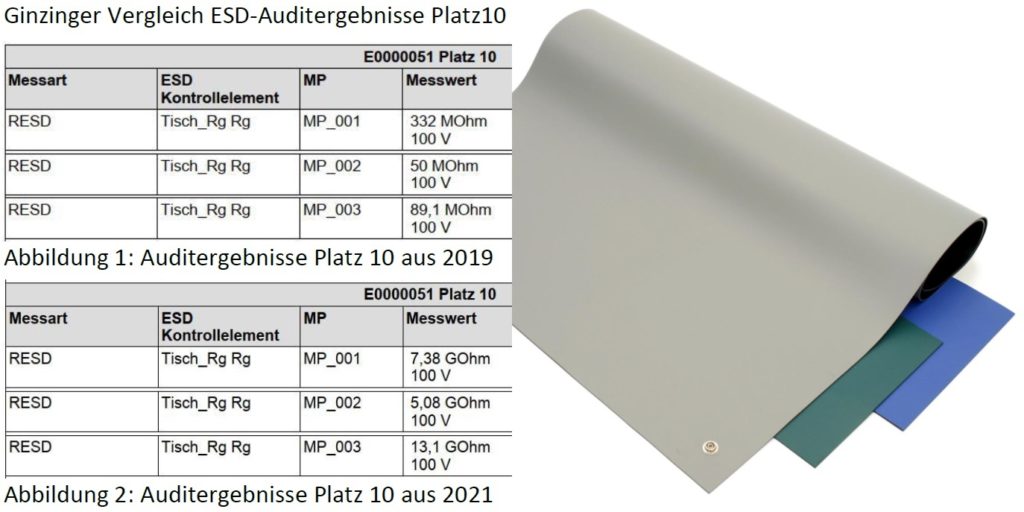
Experience reported by Reinhard Schmeitzl, ESD coordinator at GINZINGER ELECTRONIC SYSTEMS, during the Stat-X update course on 19 January 2022.
Our answer
The report describes a marked increase: while annual checks had previously typically identified three to five problematic synthetic rubber mats, the total in 2021 was 22. According to the presenter, this was the highest figure in twelve years.
During the same period, cleaning had been switched to a commercially available disinfectant as part of pandemic hygiene measures. The experience report linked the increased wear to this change.
For practical purposes, the changed process condition is particularly relevant: a cleaning agent can leave residues or attack the surface and material. Both can change measured values and fitness for use. However, this single report does not prove that every disinfectant damages every ESD mat.
For your practice
Coordinate hygiene requirements with material compatibility. Use approved products and check electrical properties after changes to cleaning. Further cleaning may remove residues but does not automatically reverse material damage.
Why should insulators unrelated to the process be identified as soon as they enter the EPA?
From technical discussions: can electric fields endanger sensitive structures even if nobody directly touches the component?
Our answer
A charged insulator can generate an electric field without touching the electronics. This field can displace charges in nearby conductive structures. Subsequent making or breaking of contacts can cause critical discharges.
The original Stat-X answer referred to a contribution by Thomas Sebald on electrostatic charges on wafers and photomasks, discussed at the 2023 ESD Symposium in Tallinn. The key point: in very small structures, potential differences caused by field effects can also promote local discharges between neighbouring structures. External contact by a person is not always necessary.
This semiconductor manufacturing example cannot be applied universally to every assembly. It does show why assessment must go beyond personnel grounding and visible contact. Without the full experimental conditions, the numerical values in the earlier text are not general operational limits.
For your practice
Remove unnecessary insulating objects from the sensitive process area. Assess necessary insulators at their actual point of use, including distance, movement and possible charging. Field measurements help the investigation; they do not automatically replace the other required ESD tests.
Testing and measurement
Is a 100 V test voltage a problem for pregnant employees or people with implants?
An everyday workplace question: can all employees use the EPA entrance tester with a 100 V test voltage?
Our answer
The test voltage alone supports neither a general all-clear nor a conclusion that the device is unsuitable. The specific tester, its limited test current, waveform and current path through the person are decisive, together with individual circumstances.
At the test setup: Which personnel grounding products are being tested? Does the measurement path run from hand to foot or between other contact points? What resistances and contact conditions occur?
At the device: What does the manufacturer state about current limitation, measurement signal, power supply and permitted users? Technical evidence for a different tester cannot automatically be transferred.
For the person: Pregnancy and an active medical implant are different issues. For implants, their design and manufacturer’s instructions must also be considered. Clarification therefore belongs in the specific workplace assessment, involving occupational safety and occupational medicine.
For your practice
Obtain the information for the tester actually used and have unresolved questions clarified before use. A contactless alternative may perform a different measurement task; its suitability as a replacement must be checked. It does not automatically remove the need for workplace assessment.
DGUV: background information on employees with implants – general background, not approval of a specific ESD tester.
Why does an employee fail the ESD test in the morning?
Customer question from the first ESD tutorial in Ulm: particularly on dry winter mornings, we see more failures at the footwear tester. What causes this?
Our answer
The tester assesses an entire contact path: test contact, person, socks, footwear and measurement electrode. An unfavourable result therefore does not automatically mean that the footwear is defective. Dry skin, unsuitable insoles, dirty soles or contact conditions may also play a role.
In the original exchange of experience, participants reported that some person–footwear combinations changed behaviour only after approximately 15 to 30 minutes of wear. Increasing moisture inside the shoe was discussed as an explanation. This is a practical observation for certain combinations, not a universal waiting time or approval despite a failed test.
Comparison is especially helpful: does the problem affect only one person, one shoe model, one tester or many employees at once? This indicates whether to first examine contacts and footwear or the tester and environmental conditions.
For your practice
Check sole condition, socks, approved insoles, measurement contacts and device function. Measure again after cleaning or correction. Until personnel grounding has been demonstrated under the workplace procedure, an approved alternative protective measure is required; merely waiting or bypassing the tester is insufficient.
What practical problems can I avoid in a walking test?
A question from measurement workshops: why do results differ even when the same person walks on the same floor?
Our answer
The walking test investigates charging in the person–footwear–flooring system. It supplements resistance measurement with behaviour during movement. A favourable resistance value alone therefore does not fully explain the personnel charging that occurs while walking.
In their 2015 technical article, Christian Hinz and Jörg Thürmer examined practical measurement setups and the comparability of measurement systems. This experience remains useful, although testing today must use the applicable edition of the standard and the current equipment procedure.
Preparation should define the footwear, floor areas, cleaning and climatic conditions. During measurement, movement sequence, contact arrangements, measuring lead and instrument settings must match the procedure. Evaluation must establish which signal components and peaks are assessed.
For your practice
Document the tested combination and measurement conditions so the experiment can be repeated. When results differ, first compare setup and procedure. A measurement on a particularly clean spot does not automatically represent the whole subsequent operation.
Christian Hinz and Jörg Thürmer: Practical problems in walking tests (2015, PDF)
Why did a consultant’s high-resistance measurements differ from mine?
From the Stat-X measurement workshop on 24 February 2016 in Kassel: three high-resistance meters from different manufacturers enabled a direct comparison.
Our answer
In that workshop, the instrument combinations produced closer results at lower resistances. Differences became more pronounced in the high-resistance range. The lesson: measurement uses not just an instrument, but a system of instrument, leads, electrodes and test specimen.
An instrument calibration certificate does not automatically describe the condition of every cable and electrode used. Dirt, damaged leads, contact conditions and different test voltages or measurement times can alter the result. Humidity, temperature and material conditioning also matter.
The original report described deviations of up to approximately half a decade under unfavourable conditions. Half a decade corresponds to roughly a factor of three. This is an observation in that context, not an allowable measurement tolerance for arbitrary tests.
A practical approach from the workshop was to measure several known, sufficiently stable comparison materials in the relevant resistance range before use. This can reveal changes in the complete measurement setup earlier. Such comparative measurements supplement instrument testing and calibration; they do not replace them.
For your practice
Before a comparison, align the test method, voltage, measurement time, electrodes, contact arrangements and climate. Then check the complete measurement setup using suitable references. Only then can you meaningfully determine whether the material has changed or the deviation comes from the measurement system.
Organisation and qualification
What is a product qualification database?
Customer question from ESD coordinator training in Berlin: why do we need documented product qualification if the supplier already sells the product as suitable for ESD?
Our answer
Because crucial properties cannot be recognised by appearance. A replacement item may look similar yet behave differently electrically. Approval must therefore be traceably linked to the intended application.
The product qualification database brings together evidence and approvals for the ESD control elements used. In practice, it should show which product is approved for which use, the documents or tests supporting the decision, and any restrictions to observe.
This particularly supports purchasing: approved products and sources are known, and the responsible person can be involved when a product changes. Production and quality assurance can understand why a particular item may be used.
The original question arose in connection with the 2016 edition of the standard. The practical purpose remains clear: an initial suitability assessment and subsequent operational checks serve different tasks. Qualification determines whether a product is suitable; verification checks whether its protective effect is maintained in use.
For your practice
Use a clear list or your existing management system. What matters is unambiguous product identification, intended use, evidence and approval – additional specialist software is not automatically required.
How often must I check my ESD control elements?
A customer question: the auditor was not satisfied with our inspection lists. Why should we test more frequently?
Our answer
The testing frequency must suit the task and the stability of the protective measure. Applicable requirements arise from the ESD control programme, relevant requirements and agreed customer requirements. Your own measurement results and experience also help determine appropriate intervals.
The original Stat-X answer uses an illustrative example: a grounding cable breaks shortly after an inspection. If this is noticed only at the next annual inspection, it remains unclear for a long time when protection was lost. The longer this period, the greater the effort may be to retrospectively assess affected products. This does not automatically require a recall; the specific risk must be investigated.
Personnel grounding, movable cables, heavily used castors or ionisers prone to contamination change differently from permanently installed equipment. A single annual date for all elements is therefore not necessarily appropriate.
The previous practical article recommends checking personnel grounding before work starts and monitoring especially changeable elements more closely. Such procedures must fit your system; continuous monitoring, usage and documented stability should also be considered.
For your practice
Justify intervals using usage, risk of change, component sensitivity and previous results. Check additionally after relevant repairs, changes or unusual findings. If faults are regularly found, review the interval and cause as well as repairing them.
Standards overview: compliance verification under IEC TS 61340-5-4
How often must I conduct training in my organisation?
A customer question: the standard says “regularly”. What does that mean specifically for our company?
Our answer
A training concept should define who needs which knowledge, when initial instruction takes place, and how that knowledge is refreshed and checked. “Regularly” must therefore be reflected in a planned process, not just occasional training when an opportunity arises.
The previous Stat-X practical article cited annual and two-year refresher cycles as examples from companies. These examples are not universal standard requirements. An experienced, stable team may need a different scope from one facing frequent staff turnover, new processes or recurring errors.
Employees must understand the rules for their specific activities. A short practical refresher at the workplace may therefore be more useful than a lengthy general presentation. What matters is whether learning is applied in everyday work.
Further training for ESD coordinators and other specialists must be distinguished from this. They must follow technical developments and keep their knowledge current. Certificate validity depends on the training provider; it does not automatically determine the instruction cycle for the workforce.
For your practice
Plan initial instruction, refresher training and training prompted by specific events separately. Use observations, questions and test results to adjust content and frequency. Technical events, measurement workshops and update courses give those responsible for ESD opportunities to exchange experience.
What does effective ESD protection cost?
From a 2017 technical article: running costs were compared illustratively with an employee’s daily break-time coffee. How should this be understood?
Our answer
The comparison was intended to show that a sensibly structured ESD system can be operated with manageable ongoing effort. It was not a price promise for every company and does not replace a current calculation.
Your starting position and processes are decisive when assessing costs: what equipment is already available? Which components are handled? Which checks, training and organisational tasks are required? One-off investments and ongoing expenses should be considered separately.
The article by Christian Hinz and Jörg Thürmer emphasises the importance of an appropriate ESD team and a control programme practised daily. When cleaning, visual checks and correct behaviour are embedded in routine work, problems less often need to be corrected retrospectively under time pressure.
Purchasing and product approval also affect costs. An initially cheap item can become expensive through poor suitability, a short service life or additional testing. Conversely, buying as many protective products as possible does not save money if they do not address the actual process task.
For your practice
Record investments, ongoing support and existing measures. Use historical cost examples as a starting point and calculate using your current quantities, prices and working hours. The goal is a suitable system that remains effective over time.
Christian Hinz and Jörg Thürmer: Organisational requirements and cost examples (2017, PDF)
Is your question still unanswered?
Describe your specific situation: what was observed, which materials or devices are involved, and under what conditions does the problem occur? For measurement questions, details of the method, setup and results are helpful.
Send a question to the competence centreWe may include frequently recurring questions anonymously in this knowledge section.
Experience behind the answers and further technical information
This collection is based on the original Stat-X customer questions and practical reports. These include the Kassel measurement workshop in 2016, the logistics workshop in 2017 and the Ginzinger experience report from the January 2022 update course. Historical measurement results relate to the samples and conditions examined at the time.
The linked technical articles by Christian Hinz and Jörg Thürmer explore the walking test (2015) and organisation and costs of ESD protection (2017). References to standards in older articles should be read in the context of their publication year.
Current starting points are provided by our standards overview and the electrostatics basics. The FAQ explains typical relationships; specific test limits and procedures follow from the edition of the standard applicable to your application, the manufacturer’s instructions and your ESD control programme.